


By Ilir Demalia
Korçë is one of the most beloved and distinctive cities in the Albanian lands. It is a city that has made an irreplaceable contribution to history, culture, music, and the development of the Albanian language. Known as the city of serenades, of national education, and of early civic culture, Korça remains a unique identity on the Albanian map.
The Korçë Serenades, born in the late 19th century and cultivated over decades, soothe the soul and bring a gentle smile. They are best enjoyed along the cobblestone streets, among the elegant villas of the 1920s and 1930s, built by the wealthy merchant class of the time and strongly influenced by Italian and French architecture. Many of these buildings were unfortunately neglected for years, but a significant number have now been restored to their former identity.
One of the architectural wonders of the city is the Old Bazaar of Korçë, carefully restored and transformed into a lively center of gastronomy, crafts, and culture. It adorns the city like a necklace of pearls, preserving the spirit of old Korça.
Unlike the rapid and often unregulated developments seen in Tirana or Durrës, Korça has largely managed to preserve its historical and architectural identity. Although saddened by the mass emigration of young people, the city is brought to life by tourists who come from across Albania, the Balkans, Western Europe, and even the United States to experience this city with an aristocratic spirit.
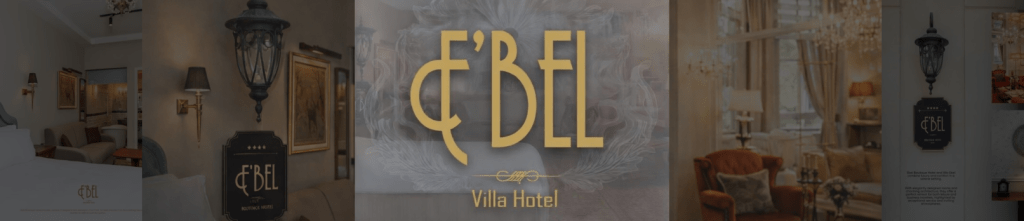
If Korça is the city of serenades, cobblestone streets, and early civic aristocracy, then Ebel Boutique Hotel is the modern translation of this heritage into a tourism experience. It is not simply a place to sleep—it is a tourist attraction in its own right, a stop worth enjoying even if you are not staying at the hotel.
Architecture That Speaks Softly, Yet with Dignity
The villa, dating from 1925–1935 and built in a neoclassical-eclectic style with Italian influences and neo-Baroque elements, reflects the spirit of Korça’s merchant class during the golden period of 1920–1940. Its restoration has not been a superficial intervention but a true restoration of identity.
The following elements have been preserved:
• The proportions and symmetry of the façade
• Decorative frames and ornaments
• Handcrafted wooden details
• Harmony between the historical volume and the modern additions
The complex has been expanded with finesse, preserving the character of the villa while creating a small “micro-neighborhood” within the neighborhood—an oasis of calm just minutes from the Old Bazaar of Korçë and the vibrant life of the city boulevard.
An Experience, Not Just Accommodation
Ebel should be enjoyed as a complete experience.
Breakfast in the courtyard
In the inner garden, with a fountain at its center and carefully curated greenery, breakfast becomes a ritual. Sunlight filtering through the stone walls creates an intimate, peaceful atmosphere—almost meditative.
Afternoon at the glass-pyramid bar
The glass structure allows natural light during the day and creates an elegant atmosphere in the evening. Traditional Korça music or soft instrumental melodies blend past and present. It is a place where foreign visitors discover local culture while locals reconnect with nostalgia.
The restaurant as an art gallery
The presentation of dishes is aesthetic and carefully composed—so beautiful that you almost hesitate to touch them. The cuisine blends local ingredients with modern interpretation. Every detail—from the tableware to the attentive and ethical service—reflects high standards and a refined culture of hospitality.
Rooms – Intimacy and Romance
Each room has its own personality. Exposed brick walls, dark-toned wooden furniture, warm textiles, and soft lighting create an environment that invites you to slow down. It is a space that encourages tranquility, reflection, and romance.
In the basement level, relaxation areas with a pool, jacuzzi, sauna, Turkish bath, and massage rooms offer another dimension of comfort. Like everything else in the hotel, these spaces reflect taste, cleanliness, and exceptional service.
Foreign tourists often seek “authenticity.” At Ebel, authenticity is not artificial décor—it is historical continuity.
A Model for Cultural Tourism
At a time when global tourism is shifting toward authentic experiences and historic spaces, Ebel Boutique Hotel represents a model of sustainable urban development:
• Preservation of architectural heritage
• Revitalization of a historic building
• Integration with the identity of the city
• Promotion of quality tourism rather than mass tourism
In this sense, Ebel is not only a hotel—it is part of the cultural story of Korçë itself. ✨


